

March Madness at Work: How Much Americans Spend on Office Pools and Other Tournament Habits
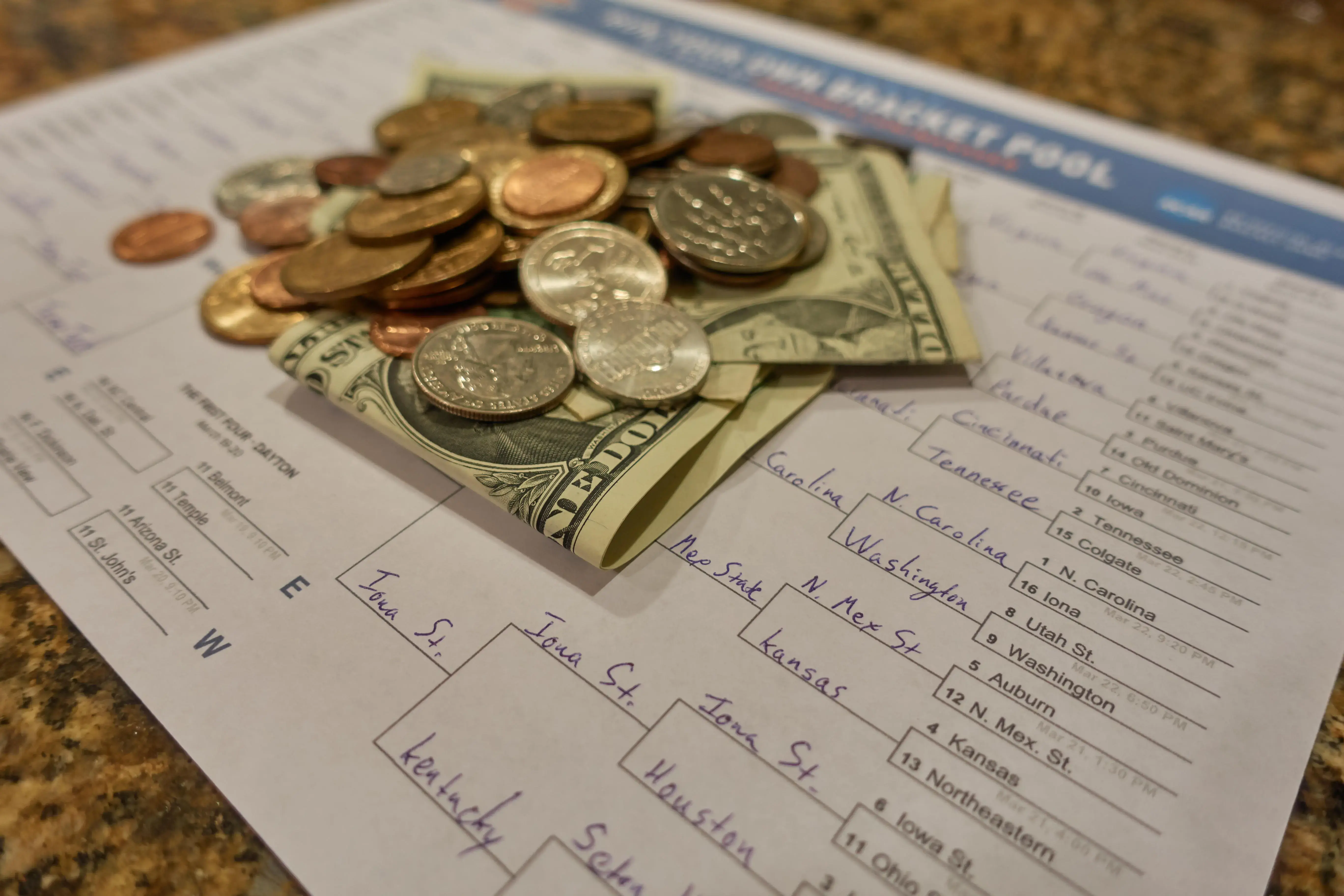
Every spring, the NCAA tournament spills beyond the basketball court and into workplaces across the United States. Employees fill out brackets, join office pools and keep tabs on tournament games throughout the workday.
To understand how the tournament plays out at work, we surveyed more than 3,000 full-time U.S. workers about their March Madness habits — including how much they spend on office pools, whether they use AI tools such as ChatGPT to help pick their brackets, and whether the excitement of the tournament has ever led to trouble at work.
Three key questions
- How much money workers typically put into office March Madness pools each year
- Whether workers use AI tools such as ChatGPT to help pick their brackets
- Whether employees have ever gotten into trouble at work because of March Madness
March Madness has become a regular part of workplace culture, shaping how employees engage with the tournament during the workday. From billions of dollars in office pool spending to growing interest in AI-assisted bracket strategies and occasional workplace trouble tied to the games, the findings show how the tournament now extends well beyond the court.
Before diving into the key findings, those getting ready to fill out their brackets can also take a look at VegasInsider’s latest NCAA winner odds for additional context. Readers interested in sportsbook offers can find further details on our bet365 Bonus Code page.
Table of Contents
Key Findings
- Nearly 6 in 10 full-time workers (59%) spend money on office March Madness pools, with the average participant putting in about $97 per year — adding up to an estimated $7.7 billion nationwide.
- AI is becoming part of the bracket process: 38% of workers say they have used AI tools such as ChatGPT for March Madness brackets, while 52% say they will use or would consider using AI this year.
- About 1 in 5 workers (21%) say they have gotten into trouble at work over March Madness, whether through a formal warning or an informal call-out from a manager.
- New York leads the country in office pool participation, with 76% of workers saying they put money into March Madness pools.
- Florida ranks highest for past AI-assisted brackets, with 57% of workers saying they have used AI tools to help pick their tournament brackets.
- Washington reports the highest rate of March Madness-related trouble at work, with 49% of workers saying they have gotten into trouble over the tournament.
Analyst quote
“March Madness has grown into a full workplace ritual, where office pools, bracket talk and now AI-assisted picks all shape how employees experience the tournament. What stands out is that this is no longer just about casual fandom — it now involves real money, new technology and, for some workers, real consequences on the job.”
— VegasInsider analyst
Office March Madness pool spending
Office pool participation is widespread, with 59% of full-time workers saying they spend money on March Madness pools. Among those who take part, the average annual spend is about $97. Applied nationally, that suggests roughly 80.1 million workers could be putting an estimated $7.7 billion into office pools each year.
Participation is especially strong among younger workers, with those aged 25–34 accounting for roughly a quarter of office pool participants.
State highlights
- New York ranks highest, with 76% of workers saying they spend money on office March Madness pools.
- Florida follows at 75%, while Kentucky, Illinois and North Carolina are all tied at 71%.
- Large states such as Texas (66%) and California (63%) also report strong office pool participation.
- At the other end of the spectrum, North Dakota and New Hampshire (36%) report the lowest levels of office pool participation, followed by Oklahoma (38%).
AI use for March Madness brackets
AI is already influencing how many workers approach their brackets. Overall, 38% of respondents say they have used AI tools such as ChatGPT for March Madness brackets in the past, while a majority (52%) say they will use AI or would consider using it this year.
AI use is especially common among workers aged 25–44, who lead both in past use and openness to AI-assisted bracket decisions.
State highlights
- Florida ranks highest for past AI use, with 57% of workers saying they have used AI tools for March Madness brackets.
- California and New York follow closely behind at 56%, suggesting AI-assisted bracket strategies are already common in some of the country’s largest states.
- North Dakota reports the lowest past AI use, with just 10% of workers saying they have used AI for March Madness brackets.
- Washington and Virginia lead the country in future AI adoption, with 67% saying they will use AI or would consider using it for brackets this year.
- New York (64%) and Georgia (63%) also rank among the states most open to using AI tools for bracket decisions.
- North Dakota again ranks last, with just 30% planning to use or consider using AI for their brackets.
Workplace trouble during March Madness
While March Madness is often seen as harmless fun, the tournament can sometimes spill into the workplace itself. About 1 in 5 full-time workers (21%) say they have gotten into trouble at work over March Madness, whether through a formal warning or an informal call-out from a manager.
Younger workers appear most at risk, with those aged 18–24 the most likely to report March Madness-related trouble at work.
Singles also report slightly higher trouble rates, which may reflect their higher participation in office March Madness pools (63%) compared with married workers.
State highlights
- Washington ranks highest, with 49% of workers reporting some form of March Madness-related trouble at work.
- Georgia (42%) and New York (40%) follow closely behind, suggesting these issues are especially common in several large states.
- Texas (37%) and California (36%) also rank among the top states for workplace trouble tied to March Madness.
- North Dakota reports the lowest level of workplace trouble, with just 2% saying they have gotten into trouble over March Madness.
- Wyoming (4%) and Minnesota (6%) also rank among the states with the lowest levels of March Madness-related workplace trouble.
Bottom line
March Madness is no longer just a sporting event — for millions of Americans, it is also part of workplace culture. From office pool spending and AI-assisted brackets to the occasional run-in with managers, the tournament now plays out well beyond the court. Most of it is friendly fun, but the findings show just how firmly March Madness has become part of office life.
Methodology
This analysis is based on a survey of 3,032 full-time U.S. workers conducted in February 2026. Respondents were asked about their participation in office March Madness pools, their use of AI tools such as ChatGPT for bracket predictions, and whether they had experienced workplace consequences related to the tournament.
State-level results reflect the share of respondents in each state reporting these behaviors. National spending estimates were calculated by applying the survey participation rate to the latest U.S. Bureau of Labor Statistics estimate of 135.8 million full-time workers, combined with the average office pool spend of $97 per participant.
All research was conducted in accordance with the MRS Code of Conduct (2023) and the ICC/ESOMAR International Code on Market, Opinion and Social Research. Research Without Barriers is registered with the Information Commissioner’s Office (ICO) and complies with the General Data Protection Regulation (GDPR) and the Data Protection Act 2018.