

ProphetX Rolls Out Its Parlay Feature: How a Sports Exchange Is Reinventing Parlays

Updated on 9/30/26

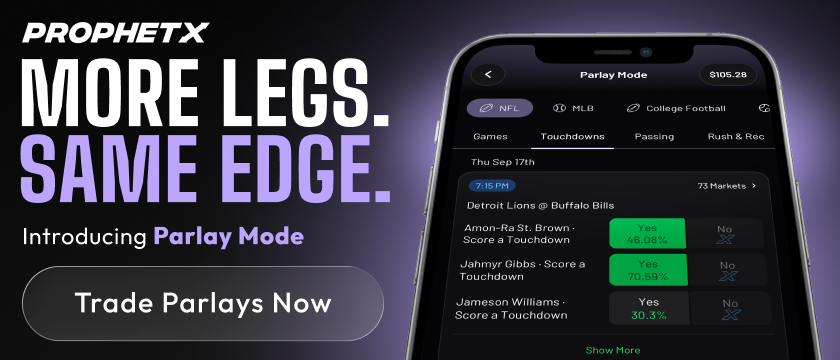
For decades, the parlay has been the sportsbook's favorite product and the bettor's riskiest indulgence: string together a handful of picks, multiply the odds, and chase a big payout, all while the house quietly bakes in extra margin on every additional leg. ProphetX, the peer-to-peer sports prediction market, is trying to break that model with a parlay feature built less like a sportsbook promotion and more like a trading desk tool.
Use our ProphetX promo code
A Parlay Built on Request-for-Quote, Not a House Price
Most sportsbook parlays work the same way: the book prices each leg, multiplies the odds together, shaves off some value for itself, and hands you a single combined price. ProphetX's version flips that structure. Instead of a single operator setting the price, users submit a request for quote (RFQ) on their desired multi-leg combination, and other traders on the exchange respond with their own prices for taking the other side. Whoever offers the best terms fills the order.
That means the parlay price is discovered by the market itself rather than dictated by a sportsbook's risk desk. ProphetX's co-founders have described this as bringing an institutional trading mechanism, similar to how block trades or complex options combinations get priced on Wall Street, into a space that's "entirely new to the sports derivatives domain."
Why It Matters: Exchange Odds vs. Sportsbook Odds
The core pitch of ProphetX has always been its exchange model. Users trade contracts against each other, paying a thin commission instead of absorbing a built-in house edge. Applying that same principle to parlays is a bigger deal than it sounds, because multi-leg bets are traditionally where sportsbooks make their best margins; the "hold" compounds with every leg added. A peer-to-peer parlay mechanism, at least in theory, lets that inflated margin get competed away by other traders rather than pocketed by the house.
How It Fits Into ProphetX's Broader Push
The parlay mechanism isn't a standalone gimmick, it's part of ProphetX's transformation into a federally regulated financial exchange. The company filed with the CFTC in late 2025 to register as both a Designated Contract Market and a Derivatives Clearing Organization, clearing the way to operate nationally under federal oversight rather than a state-by-state sportsbook license. That approval came through in June 2026, and the RFQ parlay system was highlighted throughout the filing as one of the platform's signature innovations.
Since then, the company has used the feature as a centerpiece of its growth story, pointing to it in its $35 million funding round as a key driver of its plan to triple trading volume in 2026, alongside B2B partnerships that let other platforms plug into ProphetX's infrastructure.
What It Looks Like for Everyday Users
In practice, building a parlay on ProphetX means selecting multiple outcomes across games or props, submitting the combination for a quote, and getting matched against real counterparties rather than a fixed in-house price. Some coverage of the platform has noted that the parlay tools were still rolling out in a limited or beta capacity for retail users even as the underlying RFQ mechanism powers the institutional and B2B side of the business.
The Bigger Picture
Whether or not "parlay" is even the right word for what ProphetX is building is part of the point. The company is explicitly trying to import the mechanics of financial derivatives trading into sports betting's most popular and most profitable (for the house) product. If it works as advertised, bettors get parlay pricing shaped by competition among peers instead of a single sportsbook's algorithm, a meaningfully different value proposition in a category that's become nearly synonymous with online sports betting itself.