

CFB Win Totals on Kalshi: How to Read and Trade the October 2026 Board

Kalshi lists 69 college football win totals for the 2026 season, and they work differently than the over/under at your sportsbook.
You buy a "Yes" or "No" contract on whether a team clears a regular-season win threshold. Prices run 1¢ to 99¢ and pay $1 if you're right. A contract at 51¢ means the market thinks it has a 51% chance of happening.
These Kalshi NCAA football win totals contracts settle the moment the outcome is decided, not in December. And you can sell any time before that. If your team starts 4-0, most of your gain shows up by October and you can take it and go. Only regular season games count, so conference title games, bowls, and playoff games are out.
Keep reading to learn how the ladders work, what the prices tell you, how they move on Saturdays, and where all 69 boards stand right now.
How Kalshi NCAA Football Win Totals Work
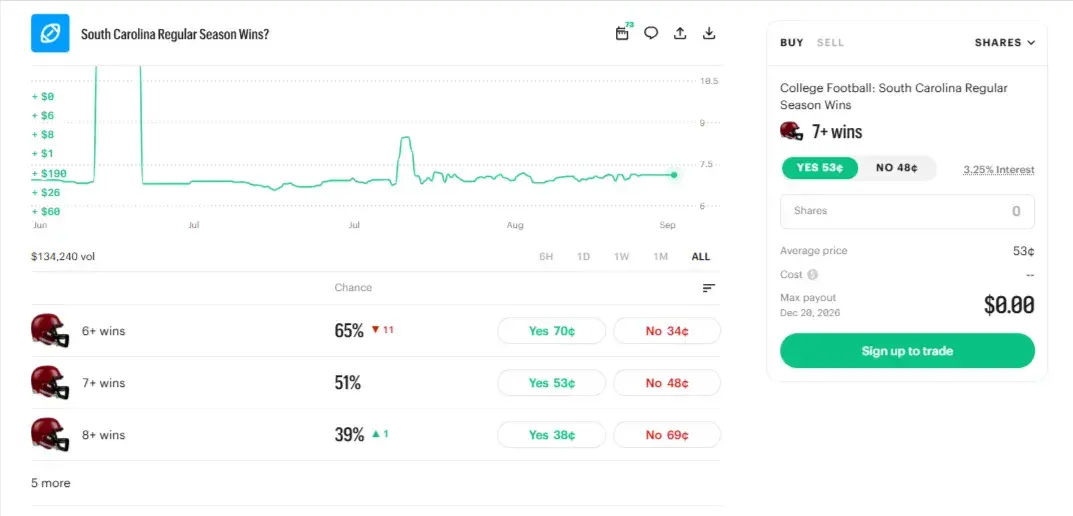
Every team on the board gets its own market, split into thresholds. South Carolina has markets for 6+ wins, 7+ wins and so on down the line. Teams on the current board carry around seven to 12 thresholds each, which means one opinion can be expressed several ways at several prices.
Buy "yes" if you think the team clears the number. Buy "no" if you don't. Contracts trade between 1¢ and 99¢, and the price reads as implied probability — 65¢ is the market pricing that outcome at roughly 65%, before fees.
Settlement comes at $1 for a correct position and $0 for an incorrect one, based on regular season wins only. Conference championship games, bowl games, and playoff games don't count.
The threshold structure is what makes this different from a single futures number. If you like a team but not enough to back its ceiling, there's usually a lower threshold trading at a price that fits the opinion you actually have.
Where the Money Is: Most Active CFB Win Totals Markets
The volume on these markets doesn't follow the polls. South Carolina is the most heavily traded win totals market by a distance. Ohio State, a national championship contender, sits at nearly a tenth of that.
| 🏈 Team | 🎯 Top Threshold | 📈 Price | 📊 Volume |
|---|---|---|---|
| South Carolina | 7+ wins | 55¢ | $139,768 |
| Oklahoma State | 7+ wins | 55¢ | $73,584 |
| Oklahoma | 9+ wins | 46¢ | $67,462 |
| California | 7+ wins | 52¢ | $60,718 |
| USC | 9+ wins | 48¢ | $56,016 |
| BYU | 10+ wins | 44¢ | $50,878 |
| Alabama | 9+ wins | 59¢ | $50,354 |
| Nebraska | 7+ wins | 49¢ | $47,542 |
| Florida | 8+ wins | 41¢ | $44,049 |
| Texas | 10+ wins | 47¢ | $40,788 |
As of September 1, 2026. Volumes on Kalshi change by the minute.
What those teams share is a genuine argument on both sides. South Carolina's 7+ contract sits at 55¢, which is the market admitting it doesn't know. Oklahoma State, California and BYU have all traded more than Georgia, Oregon, Miami or the Ohio State Buckeyes.
There's a reason for that. A contract at 90¢ leaves nine cents of upside and 90 of downside, so nobody wants either side of it. Volume collects near a coin flip, where a strong opinion is worth the most, and the market on a heavy favorite barely moves all season.
Top College Football Win Totals By Conference
Most college football teams play 12 regular season games, and these win totals cover those games only. Bowl games and College Football Playoff games sit in separate markets.
Two teams carry a 12-win contract: Notre Dame at 35¢ and Texas Tech at 39¢. Notre Dame's 11+ wins sits at 70¢, the shortest of any team with a double-digit threshold, and Notre Dame is the only independent on the board.
Six teams have an 11+ contract in play: Georgia, Indiana, Oregon, Ohio State, Miami and Texas Tech. Only Miami and Texas Tech are priced above even money there.
Here's where the ladders sit across the power conferences:
| 🏟️ Conference | 🏈 Team | 🎯 Threshold | 📈 Price |
|---|---|---|---|
| SEC | Georgia | 11+ wins | 44¢ |
| SEC | Texas | 10+ wins | 47¢ |
| SEC | Alabama | 9+ wins | 59¢ |
| SEC | LSU | 9+ wins | 54¢ |
| SEC | Texas A&M | 9+ wins | 47¢ |
| SEC | Ole Miss | 9+ wins | 48¢ |
| SEC | Oklahoma | 9+ wins | 46¢ |
| SEC | Tennessee | 8+ wins | 54¢ |
| SEC | Florida | 8+ wins | 41¢ |
| SEC | South Carolina | 7+ wins | 55¢ |
| Big Ten | Oregon | 11+ wins | 46¢ |
| Big Ten | Indiana | 11+ wins | 47¢ |
| Big Ten | Ohio State | 11+ wins | 42¢ |
| Big Ten | Penn State | 10+ wins | 52¢ |
| Big Ten | USC | 9+ wins | 48¢ |
| Big Ten | Michigan | 9+ wins | 45¢ |
| Big Ten | Illinois | 8+ wins | 41¢ |
| Big Ten | Nebraska | 7+ wins | 49¢ |
| ACC | Miami (FL) | 11+ wins | 55¢ |
| ACC | SMU | 9+ wins | 61¢ |
| ACC | Virginia | 9+ wins | 58¢ |
| ACC | Louisville | 8+ wins | 61¢ |
| ACC | Clemson | 8+ wins | 59¢ |
| ACC | Virginia Tech | 8+ wins | 50¢ |
| ACC | California | 7+ wins | 52¢ |
| ACC | Georgia Tech | 7+ wins | 47¢ |
| ACC | North Carolina | 6+ wins | 52¢ |
| Big 12 | Texas Tech | 11+ wins | 63¢ |
| Big 12 | Utah | 10+ wins | 44¢ |
| Big 12 | BYU | 10+ wins | 44¢ |
| Big 12 | Kansas State | 9+ wins | 44¢ |
| Big 12 | Oklahoma State | 7+ wins | 55¢ |
| Big 12 | West Virginia | 7+ wins | 47¢ |
| Big 12 | TCU | 7+ wins | 49¢ |
| Big 12 | Colorado | 5+ wins | 45¢ |
| Independent | Notre Dame | 12 wins | 35¢ |
As of September 1, 2026. Kalshi contracts reprice continuously.
Texas and Oklahoma now play a full SEC schedule, and Oregon, USC, UCLA and Washington moved to the Big Ten. Both shifts are priced into these numbers, though not always at the same speed.
What Moves a Win Total
These markets reprice all year. What moves them:
- Results. Nothing moves college football win totals like actual games. Three wins to open the season pull the lower thresholds toward $1 while the higher ones lag, since the tough games on the regular season schedule are still ahead.
- Quarterback news. A transfer portal arrival, an unsettled depth chart or an injury to a starter can reprice every threshold for that team in a day.
- Where the hard games sit. Two teams with the same projected record can be priced very differently depending on when the tough games land. A team that cruises through nonconference play in September can still have three toss-ups waiting in November.
- Attrition. Injuries pile up through October. A team down its starting quarterback is less likely to win every remaining game, not just the next one. Needing four wins from six is a different proposition in November than it looked in August.
A sportsbook futures ticket is locked in the moment you take it. A win total contract moves every Saturday, which cuts both ways — more chances to be right, and more chances to talk yourself out of a good position.
How to Trade CFB Win Totals on Kalshi
- Open an account and verify. Standard identity check, and it has to clear before you can fund or withdraw.
- Fund the account. Debit card, bank transfer and instant options are all supported.
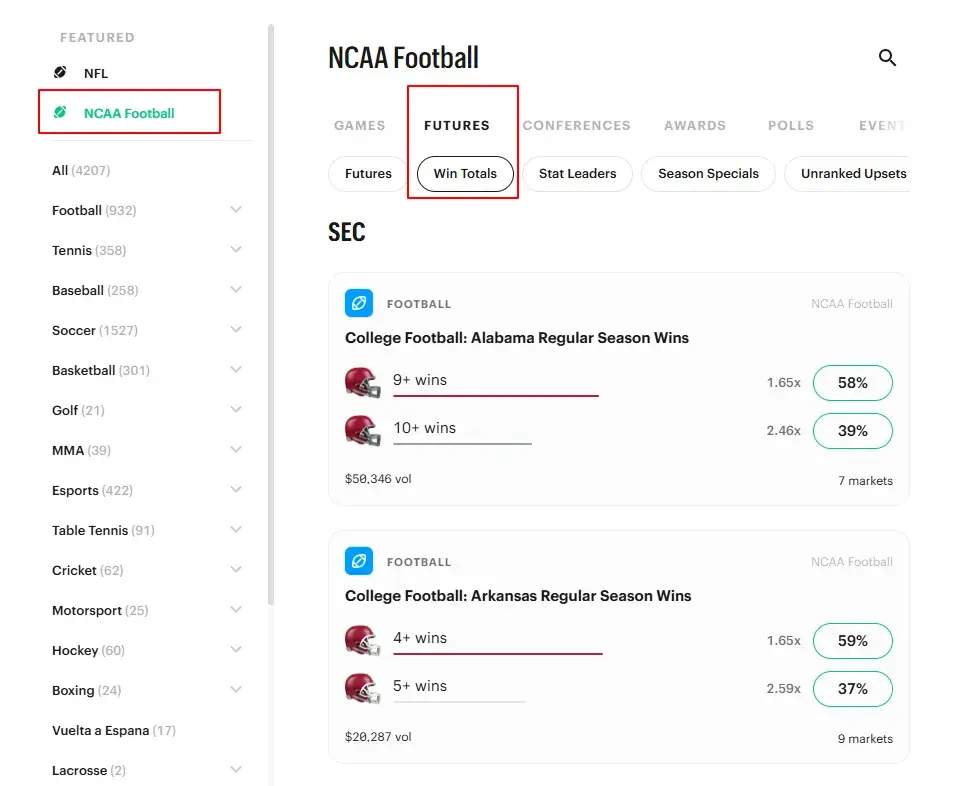
- Find the college football futures market tab, then Win Totals.
- Pick a team and a threshold. Read across the thresholds before committing, because the number you want may be one line up or down.
- Choose your order type. Take the price on screen, or post a limit order at your own number and wait for a fill.
- Track it in your portfolio, where the position sits until you sell or it settles.
Order type matters beyond patience. Taking the number on screen costs you a fee, while resting orders that add liquidity usually cost nothing.
New accounts can use Kalshi promo code
| 🏷️ Kalshi Promo Code | |
| 🎁 New Account Offer | |
| 📝 Terms | |
| 📍 Promo Available in | AK, AL, AR, CA, CO, CT, DC, DE, FL, GA, HI, IA, ID, IN, KS, KY, LA, ME, MN, MO, MS, NC, ND, NE, NH, NJ, NM, NY, OK, OR, PA, RI, SC, SD, TN, TX, UT, VA, VT, WI, WV, WY |
| 👤 Age | 18+ |
Selling a CFB Win Total Before the Season Ends
A CFB win total at a traditional sportsbook ties your money up until the last week of the regular season. Kalshi doesn't. Here's how it works:
- Open your portfolio and find the position.
- Check what the contract is trading at now. Say you bought Nebraska 7+ wins at 49¢ in September and they open 4-0. That contract might be trading at 80¢ by early October.
- Sell into the bid, or post your own price. 100 contracts at 80¢ banks just under $28 after fees, and you never find out whether Nebraska drops three in November. It works the other way too — a position going wrong can be closed at 20¢ instead of ridden to zero.
- Check the volume first. Selling needs a buyer. The heavily-traded boards support an exit; a team that's traded a few thousand dollars all offseason is harder to get out of than into.
CFB Win Totals Fees, Funding and Payouts
Fees
Kalshi charges a taker fee that scales with where a contract sits, and CFB win totals trade right where it peaks. Most of the thresholds on the board sit between 40¢ and 60¢, which is the most expensive part of the curve.
| 💲 Contract price | 📊 Fee per 100 contracts |
|---|---|
| 10¢ | $0.63 |
| 20¢ | $1.12 |
| 30¢ | $1.47 |
| 40¢ | $1.68 |
| 50¢ | $1.75 |
| 60¢ | $1.68 |
| 70¢ | $1.47 |
| 80¢ | $1.12 |
| 90¢ | $0.63 |
| 99¢ | $0.07 |
Figures from Kalshi's fee schedule, effective July 7, 2026.
The curve is symmetrical: a 7+ contract bought at 49¢ in September costs $1.74 to enter, but selling it at 80¢ in October only costs $1.12 to exit, because the price has moved toward the cheap end of the curve.
Resting limit orders on these markets are free. The fee only applies when you take a price already sitting on the book.
Also, the fee is charged separately rather than buried in the number, which makes it easier to see than the margin inside a sportsbook's odds.
Funding and Payouts
Before you can take a position on any of the 69 win total ladders, you need to get money in your account as quickly as possible. A bank transfer can take up to five business days to settle, which is two Saturdays of price movement you'd sit out. Debit lands instantly and costs up to 2%.
| Method | Deposit speed | Withdrawal speed | Fee |
|---|---|---|---|
| Debit card | Instant | Usually within a few hours | 2% on deposits, none on withdrawals |
| Bank transfer (ACH) | Up to 5 business days | A few business days | None |
| Real-time payments (RTP) | Within minutes | Not available | None |
| PayPal / Venmo | Instant | Available | None listed |
| Cash App | Instant | Not supported | None listed |
| Crypto | Varies | Varies | Third-party processor fees |
| Wire | Varies | Withdrawals $500k+ only | None from Kalshi |
Other College Football Markets on Kalshi
CFB win totals are one category among many. Kalshi's college football markets cover:
- Individual games
- College football futures
- Conference championships
- College Football Playoff qualification and appearances
- Playoff seeds
- AP Poll placements
- Awards and award finalists
- Stat leaders and season specials.
At 69 listings, CFB win totals is one of the deeper categories Kalshi carries for the sport.
Win Total Contracts vs. Sportsbook Season Win Totals
Oddsmakers set a projected win number for each team and a sportsbook prices either side of it. Kalshi lists a ladder of thresholds and lets traders decide where each one belongs. The differences run deeper than presentation:
- Reading it. A Kalshi contract reads as a probability directly. A sportsbook number has the margin folded into the odds.
- Exit. A contract can be sold any time before settlement. A futures bet is held to the end, whatever happens.
- Cost. Kalshi charges a visible fee on the trade. A sportsbook takes its cut inside the number you were quoted.
- Structure. Kalshi contracts are binary event contracts settling at $1 or $0. A sportsbook win total is a single over/under wager.
- Regulation. Kalshi runs a CFTC-designated contract market under federal oversight. A sportsbook holds state gaming licenses.
- Access. The two maps don't line up, which is why some readers can use one and not the other.
The two don't always agree, either. When a sportsbook's odds and a Kalshi contract imply different probabilities for the same team, that gap is worth understanding before you act on it.
Kalshi Availability and Account Requirements
Kalshi is 18+, lower than the 21+ minimum at licensed sportsbooks in most states. Restrictions and eligibility requirements apply, and the welcome offer is for new users only.
Kalshi products are not available in all jurisdictions. As things stand, that means no access in Arizona, Illinois, Massachusetts, Maryland, Michigan, Montana, Nevada, Ohio and Washington. Kalshi's footprint has been shaped by ongoing state-level litigation with rulings going both ways, so treat that list as current rather than settled and check kalshi.com/regulatory for where things stand.
Read more: How Kalshi compares to other prediction market apps
Trade CFB Win Totals on Kalshi Responsibly
Event contracts carry a real risk of loss. Every position settles at $1 or $0, so a contract you paid 60¢ for can end up worth nothing at all.
Size positions so a total loss wouldn't hurt. Be careful with heavily one-sided contracts, too — one at 92¢ sits there for a reason, and 8¢ of upside doesn't cover what happens when it misses.
A season-long market also invites overtrading. Contracts move every Saturday, and reacting to all of it is a good way to hand your edge to the fees.
If trading stops feeling fun or starts affecting other parts of your life, take a break and use the available responsible trading tools and resources. Call the National Problem Gambling Helpline at 1-800-MY-RESET (1-800-697-3738), text 800GAM, or chat at ncpgambling.org/chat.
18+ only. Restrictions and eligibility requirements apply. Event contract trading involves significant risk and is not appropriate for everyone. Please carefully consider if it is appropriate for you in light of your personal financial circumstances.
CFB Win Totals on Kalshi FAQs
How do CFB win totals work on Kalshi?
You buy "yes" or "no" contracts on whether a team clears a regular season win threshold, like 8+ wins or 9+ wins. Contracts trade between 1¢ and 99¢ and settle at $1 or $0 once the regular season ends.
Which college football win totals market has the most volume?
South Carolina's 7+ wins market, at roughly $139K as of September 1, 2026. Oklahoma State and Oklahoma follow, with California and USC well down the list.
Can you sell a win total position before the season ends?
Yes, at whatever the contract is trading at, as long as there's a buyer. Liquidity is strong on the most-traded markets and thinner further down the board.
When do Kalshi college football win totals settle?
Each contract settles as soon as its outcome is decided, and anything still live closes by December 20 at 10:00 AM ET. Only official regular season games count. Conference championship games, bowl games, and playoff games are excluded, and ties don't count as wins.
How many college football win totals markets does Kalshi list?
69 at the time of writing, covering the SEC, Big Ten, ACC and Big 12 in full, plus a handful of teams from outside the Power 4.
Is Kalshi available in every state?
No. Kalshi is not available in Arizona, Illinois, Massachusetts, Maryland, Michigan, Montana, Nevada, Ohio or Washington, and that list has shifted with ongoing litigation.