

HYPERLIQUID PROMO CODE: LATEST NEWS AND UPDATES

Hyperliquid doesn't run sportsbook-style promo codes, so when people say “promo code” in this context, they’re usually talking about a Hyperliquid referral code. What does this offer give you? A 4% discount on trading fees for your first $25M in volume, with a few exclusions.
If you’re eligible to use the platform, add a referral code before your first trade, then bookmark this page. The only things you should keep in mind are the final fee rules (including exclusions) and the HIP-4 rollout timeline.
TL;DR
- Looking for the best hyperliquid referral code? Don't waste your time. Any valid referral code gets you the 4% fee discounts on your first $25M in volume.
- What the hyperliquid referral code doesn't cover: vault trades and sub accounts (those are treated differently in the system).
- Want your own code? You can create your own discount code after $10,000 in trading volume.
- Referrers earn 10% of the trading fees paid by their referred users, minus any discounts the referred user receives. These apply to the first $1 billion in trading volume of the referred user.
- Referral rewards can be claimed once they exceed $1.
- The upcoming launch details that matter most are exclusions, fees, and rollout timing.
| 🚨 Hyperliquid Promo Code | Not a sportsbook promo. Use a referral code for fee discounts (if eligible). |
| 📈 Prediction Market Launch | TBD; Possibly 2026 |
| 🇺🇸 Legal States | Front-end Terms of Use prohibit trading by U.S. persons. |
| 📲 Mobile Apps | Hyperliquid says there's no official app store app. Use official URLs or approved interfaces. |
| ✅ Info Last Verified | March 27, 2026 |
PROMO AND REFERRAL CODE STATUS (WHAT YOU CAN USE TODAY)
REFERRAL CODE VS. PROMO CODE
If someone shares a “promo code,” they’re almost always sharing a referral code or invite code. Hyperliquid’s docs frame it as fee discounts tied to early trading volume, not a rotating promo system like a sportsbook would have.
HOW TO ENTER A VALID REFERRAL CODE
You’ve got two ways to do it:
- Use a friend’s hyperliquid referral link, their unique referral link.
- Or enter the referral code on the Referrals page.
Either way, you’re doing the same thing: attaching the code to your account before you start trading.
WHAT THE REFERRAL DISCOUNT COVERS
On Hyperliquid, a referral code is basically a small fee break. If you enter one, you get a 4% discount on trading fees for your first $25M in trading volume.
- Trading fees are the little charges you pay when you place trades.
- A 4% discount means you pay 4% less in fees than you normally would. For example, if a trade would cost $10 in fees, you’d pay $9.60.
- Trading volume is the total amount you trade, not your profit. If you trade $5,000 a hundred times, that’s $500,000 in volume.
Referral discounts don’t apply to vaults or subaccounts, because those are treated as separate entities in the clearinghouse. Also, when people call it a “Hyperliquid invitation code” or an “invite code,” they usually mean the same thing: a referral code.
HOW THE HYPERLIQUID REFERRAL PROGRAM WORKS
The Hyperliquid referral program has two sides: new-user discounts, and rewards for the person sharing the code.
Creating Your Own Code
- You can create your own referral code once you’ve done $10,000 in trading volume.
- After that, you can share your code and your unique referral link.
How Referral Rewards Work
- When someone signs up with your code and trades, you receive 10% of the fees they pay, minus any discount they received.
- Those referral rewards apply up to that person’s first $1B in trading volume.
When You Can Claim
- Rewards build in quote assets, and you can claim rewards once they’re over $1.
- Claimed rewards show up in your spot balance, basically credited back to your Hyperliquid account.
WHAT IS HYPERLIQUID?
Hyperliquid is an on-chain trading platform that supports spot and perpetual futures trading.
- Spot is buying/selling an asset at the current price.
- Perpetual futures (usually just “perps”) are contracts that follow an asset’s price, but they don’t expire.
- On some platforms, you can trade them with leverage, meaning you’re controlling more than you put in. That can make wins bigger, but it can also wipe you out faster if the price moves the wrong way.
Hyperliquid runs an on-chain order book (a live list of buy and sell orders) and uses a wallet-first flow, so you connect a wallet rather than opening a typical account at a traditional exchange. In a comment letter to the CFTC, Hyperliquid Labs describes sub-second finality, “zero-gas” trading messages, and self-custodied collateral.
In short, it’s built for people who care about fills, fees, and speed, and who want advanced trading features. It sits in decentralized finance and the broader world of decentralized exchanges, even if it doesn’t feel like the usual “swap” interface.
WHAT FEELS DIFFERENT FROM CENTRALIZED EXCHANGES
If you’re used to centralized exchanges (regular crypto exchanges), here’s what you’ll notice:
- Wallet-first: You usually connect a wallet. There’s also an email option that creates a wallet address for that login.
- Gas isn’t on every trade: Placing trades doesn’t hit you with gas fees like many on-chain swaps. Deposits still use network transactions, so that part can cost gas.
Small costs add up. If you’re constantly paying trading fees as a taker, it means you’re placing orders that fill instantly by accepting the current price on the screen (you’re choosing speed, and it costs a little extra). That’s like laying -115 all season instead of -105. Not always wrong, just a habit that gets expensive.
As you can imagine, this isn’t a beginner-first app. You can learn it, but it expects you to pay attention to how things work.
AVAILABILITY AND U.S. ACCESS
Hyperliquid stated the front-end Terms of Use prohibit trading by U.S. persons. So it’s not accurate to talk about “legal states” like a regulated sportsbook map. The practical framing is eligibility and jurisdiction restrictions, how the front end enforces them today, and what changes come with an upcoming launch.
HIP-4 OUTCOME TRADING AND PREDICTION MARKETS
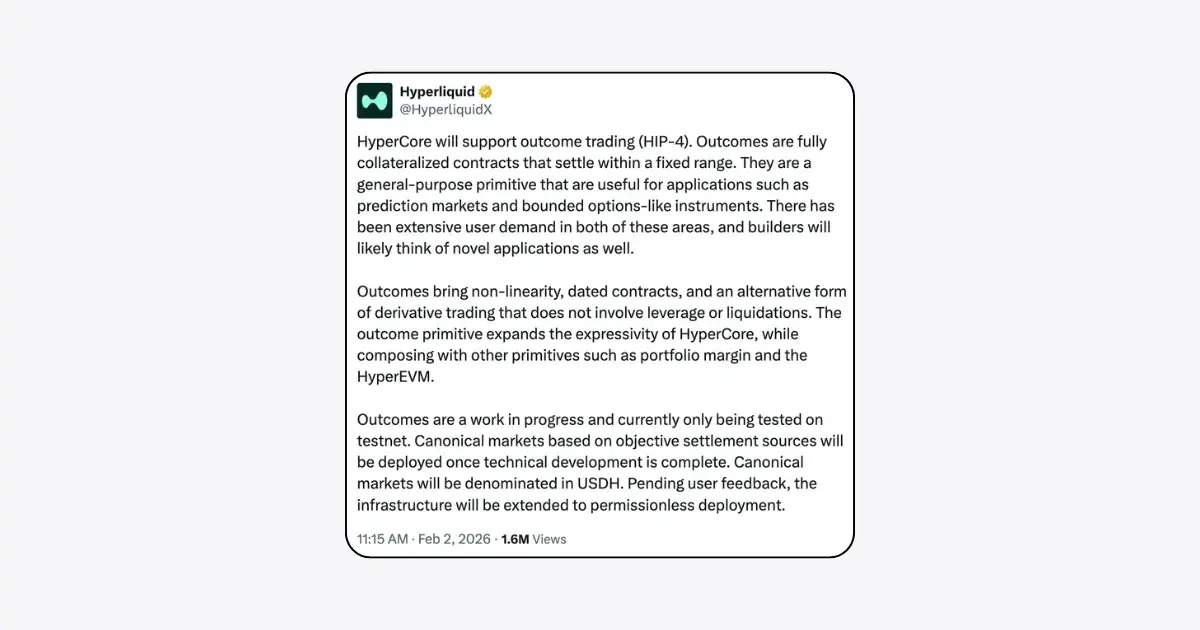
Hyperliquid has talked about adding “Outcome Trading” through HIP-4. Think of it like trading event-based contracts (the kind you see in prediction markets) inside the Hyperliquid platform. So far, Outcomes have appeared first on testnet, and there’s no publicly confirmed mainnet date yet for the first “canonical markets” (aka the initial set of official, curated markets that settle off a clear, objective source).
WHAT HIP-4 OUTCOMES ARE
Think of an Outcome as a contract tied to a real-world result. Sound familiar? It’s “prediction markets” style in the sense that it’s event-based. It’s also described as bounded and options-like, meaning the payout is shaped by a rule, not just “Yes/No.”
Outcomes are described as fully collateralized and designed to settle within a fixed range. Translation: you fund the position up front, so your maximum loss is capped to what you put in. That doesn’t make it “safe,” it just keeps the loss from running past your deposit.
HOW THIS DIFFERS FROM STANDALONE PREDICTION MARKETS
Most people think of prediction markets as their own little app. You show up, buy or sell an outcome, and the money you’re using for that lives in its own bucket.
Hyperliquid’s idea reads different. The platform wants to keep Outcomes in the same place you already trade spot and perpetual futures trading. That’s also why you’ll see “nonlinear settlement” pop up. It’s basically saying the payoff doesn’t have to be a simple Yes/No win-or-lose, and it can behave more like an options-style payout.
If you’ve only used Polymarket or Kalshi for example, the difference is there. Those are consumer-first prediction markets products, while Hyperliquid is coming from the decentralized exchanges world, so it’s closer to a trading venue than a “poll with a price.”
EXPECTED PREDICTION MARKET TYPES ON HYPERLIQUID
If Hyperliquid starts with canonical markets, the first wave of prediction markets should look a lot like “easy to verify” questions. Think of a clear timestamp, a public source, and not much room to argue about what happened.
- Economic indicators: Rate decisions, inflation reports, GDP releases, other macro numbers with official release times.
- Financial asset milestones: “Did BTC hit X?” or “Did SPY close in this range?” settled using a defined reference price.
- Politics: Results-based markets, like election markets, but only if the settlement rules are tight.
- Sports: No surprise here. Sports are a staple in prediction markets.
- Entertainment and culture: Awards, pop culture, “what happens next” markets. These can draw volume, but they also create the most settlement fights if the wording is sloppy.
TRADING FEES, TAKER FEES, AND MAKER REBATES
Hyperliquid’s trading fees come down to two things:
- Your fee tier (based on how much you’ve traded over the last 14 days)
- Whether you’re a taker or a maker on a given order
FEE TIER
Your tier is based on your rolling 14-day trading volume, meaning it looks back at your last 14 days of activity. It refreshes once a day using UTC time (so depending on where you live, you’ll notice the update at whatever that “UTC day-end” lands for you).
- Sub accounts share the same fee tier as the main account
- Vault volume is tracked separately
TAKER VS MAKER
- Taker: you place an order that fills immediately by accepting what’s already on the screen. You’re usually crossing the spread, and that’s where taker fees apply.
- "Spread" is just the gap between the best price someone will buy at and the best price someone will sell at. If you cross that gap to get filled instantly, you’re usually the taker.
- Maker: you place an order and let it sit. If someone else trades into your price, you provided liquidity. Depending on tier/product, that’s where rebates for makers can come in.
DEPOSITS AND WITHDRAWALS
Hyperliquid is wallet-first, meaning you fund it through a wallet, not the usual “bank account deposit” setup.
DEPOSIT FUNDS
Hyperliquid lists deposit paths that include USDC on Arbitrum. If you’re going to deposit USDC that way, you’ll also need a little ETH on the Arbitrum network to pay the network cost for the deposit. How come? Though placing trades doesn’t cost gas, the act of moving money in (deposit funds) is still a network transaction.
WITHDRAWALS
For withdrawals, you don’t need Arbitrum ETH on your side. Instead, you pay a 1 USDC withdrawal fee on Hyperliquid, and that covers the Arbitrum gas cost for validators.
SUPPORT, SAFETY, AND RESPONSIBLE TRADING
Since there's no Hyperliquid app on any app store, support is handled through official Discord ticket channels or their email form.
RESPONSIBLE TRADING
Fast markets are fun until you’re trading on vibes. If a number moves hard on one headline, pause and ask: do I actually know something new, or am I just chasing?
- Know what you’re trading. Perpetual futures (perps) can use high leverage, which means small moves can wipe you out fast. Outcomes (HIP-4) are meant to be fully funded, so you can’t lose more than what you put into that position. Different risk, different mindset.
- Set limits before you start trading. Pick an amount you’re willing to lose, and treat it like a budget, not “money I’ll win back.”
- Don’t let fees decide your behavior. Low fees are nice, but they’re not a reason to force trades. Bad entries cost more than fees ever will.
HYPERLIQUID PROMO CODE FAQS
WHAT IS THE HYPERLIQUID PROMO CODE?
There isn’t a sportsbook-style hyperliquid promo code. If you see people calling something the “promo,” they’re usually pointing you to a referral code.
IS THERE A HYPERLIQUID REFERRAL CODE DISCOUNT?
Yes! Entering a hyperliquid referral code gets you a 4% discount on your trading fees for your first $25M in trading volume, excluding vault trades and sub accounts.
WHEN WILL HIP-4 OUTCOMES LAUNCH ON MAINNET?
HIP-4 Outcomes are on testnet, and Hyperliquid hasn’t publicly confirmed a mainnet date for canonical markets yet.
IS HYPERLIQUID LEGAL IN THE U.S.?
Hyperliquid’s front-end Terms of Use prohibit trading by U.S. persons (per a Hyperliquid Labs CFTC comment letter).