Kalshi Election Markets: 2026 Midterms, House and Senate Predictions

| Online Sportsbooks · Kalshi · Election Markets |
Updated on 11/4/26

Kalshi election markets let you trade yes-or-no event contracts on election outcomes. Prices reflect market-implied probabilities, and winning contracts settle at $1. Kalshi operates as a prediction market exchange regulated by the Commodity Futures Trading Commission (CFTC), where traders and market makers post prices through order books rather than a traditional sportsbook.
With the November 3 midterms coming nearer, Kalshi has active markets on which party will control each chamber of Congress, individual Senate and House races, and gubernatorial elections across the country.
You can check the latest prices on Kalshi or use our Kalshi promo code
*
TL;DR
- Kalshi currently favors Democrats to win both chambers of Congress on November 3, although the Senate race is priced considerably closer than the House.
- Beyond congressional control, you can trade contracts on individual House and Senate races, gubernatorial elections, seat counts and other political outcomes.
- Contract prices reflect market-implied probabilities, which can differ from polling percentages and the prices available when you place an order.
- Check fees, settlement rules and available liquidity before trading, and keep your position sizes modest.
Current Kalshi Election Markets
Control of Congress is the headline question heading into November 3. Individual races give traders a closer look at how the midterms might play out, while Kalshi's 2026 midterm markets also cover gubernatorial elections and more specific political outcomes.
Here's where some markets stand as of November 4, 2026:
| Election market | Leading outcome | Market-implied probability |
|---|---|---|
| 2026 House Control | Democratic Party | 90% |
| 2026 Senate Control | Democratic Party | 63% |
| Texas Senate | James Talarico | 61% |
| Maine Senate | Troy Jackson | 60% |
| Michigan Senate | Abdul El-Sayed | 68% |
| Ohio Senate | Sherrod Brown | 65% |
| California Governor | Xavier Becerra | 96% |
| Georgia Governor | Rick Jackson | 51% |
| Nevada Governor | Aaron Ford | 55% |
Market snapshot: November 4, 2026. Prices fluctuate throughout the day and may differ from the amounts available when you place an order. Check each market for current pricing, volume and contract rules.
2026 House Control
All 435 House seats are up for election, and a party needs 218 for a majority. Democrats are heavily favored in Kalshi's House control market, although the exchange also identifies 31 competitive districts that could help determine the final balance.
If you're more interested in a particular matchup than the national result, two individual House markets worth following are:
- New York's 17th District: Democratic challenger Cait Conley faces Republican incumbent Mike Lawler. Kalshi favors Conley in a district where the 2024 presidential election was decided by less than one percentage point.
- Virginia's 1st District: Democrat Shannon Taylor is challenging Republican incumbent Rob Wittman. Taylor is narrowly favored on Kalshi, despite the district voting Republican in the 2024 presidential election.
Polling, turnout expectations and fundraising can move prices in individual districts without necessarily changing the broader House control market. After all, even a closely contested race accounts for just one of the chamber's 435 seats.
For more on the congressional picture, we also track 2026 US House election odds.
2026 Senate Control
Kalshi's Senate control market is much closer than the House race, with lots of competitive states potentially deciding the majority.
Republicans entered this election cycle holding 53 Senate seats, compared with 47 held by Democrats and independents caucusing with them. Democrats need a net gain of four seats to secure a majority.
There are 35 Senate elections in 2026. Republican-held seats in Texas, Maine and Ohio offer potential Democratic pickups, while Michigan's open seat is one Democrats are trying to defend.
You can trade the overall outcome through Kalshi's Senate control market, or focus on individual races.
Key 2026 Senate Races
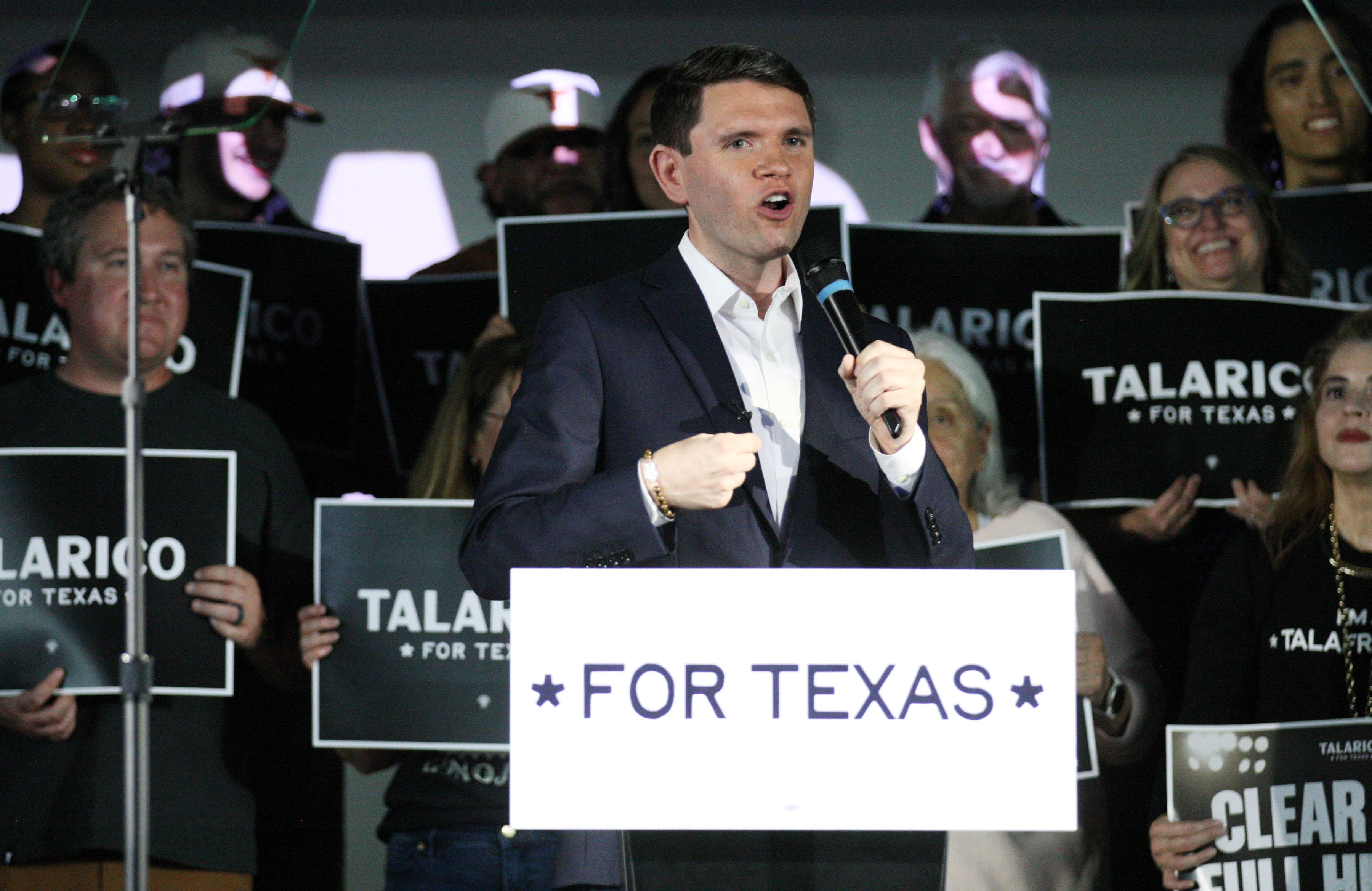
Texas: James Talarico vs. Ken Paxton
Texas is one of Kalshi's most closely followed Senate contests. Republican Ken Paxton defeated incumbent Sen. John Cornyn in the May primary runoff and now faces Democrat James Talarico.
Despite Republicans' longstanding dominance in statewide elections, Talarico leads the Texas Senate market. A Democratic victory here would be a significant pickup in the party's effort to gain control of the chamber.
Maine: Troy Jackson vs. Susan Collins
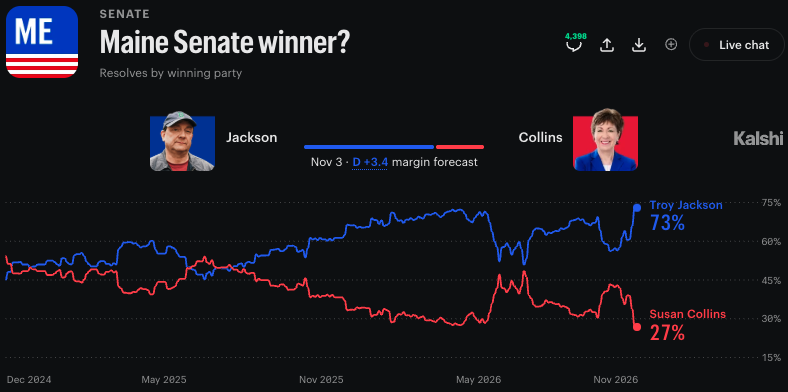
Republican incumbent Susan Collins won reelection by nine points in 2020, but Kalshi favors Democratic challenger Troy Jackson in their 2026 matchup.
That puts the Maine Senate market among the most important races for traders following the Democratic path to a Senate majority.
Michigan: Abdul El-Sayed vs. Mike Rogers
With Democratic Sen. Gary Peters not seeking reelection, Michigan has an open Senate seat. Democrat Abdul El-Sayed faces Republican Mike Rogers, and El-Sayed currently leads the Michigan Senate market.
Democrats need to hold this seat as they pursue Republican-held seats elsewhere. A loss in Michigan would mean having to make up additional ground.
Ohio: Sherrod Brown vs. Jon Husted
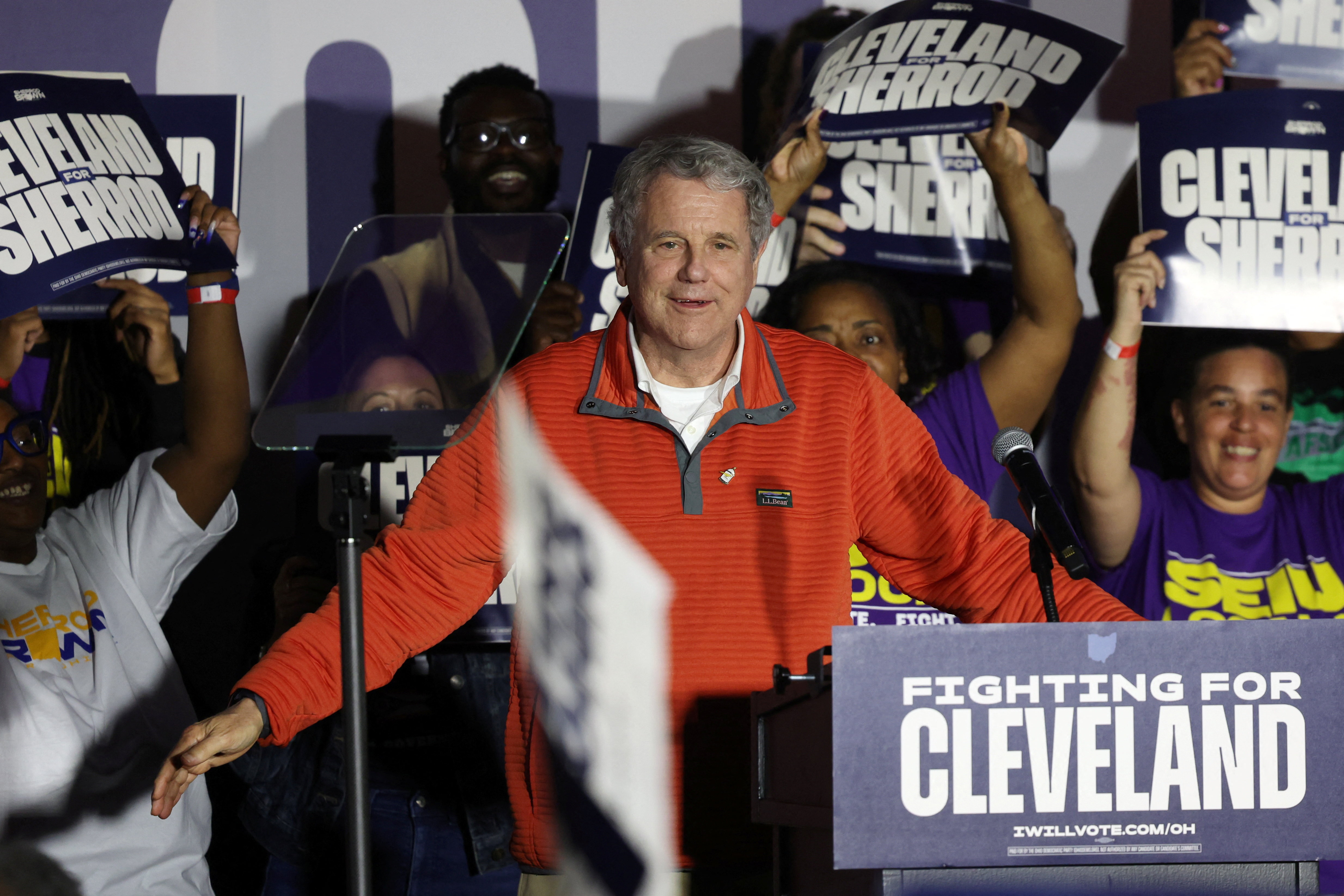
Former Democratic Sen. Sherrod Brown is challenging Republican incumbent Jon Husted, who was appointed to the seat vacated by Vice President JD Vance.
Brown is favored in the Ohio Senate market, despite Ohio's Republican lean in recent presidential elections. It gives Democrats another potential pickup in a state where they've struggled in recent statewide races.
Iowa is also worth watching. Republican Ashley Hinson faces Democrat Josh Turek, with Kalshi favoring Hinson in a race that could affect the final Senate balance.
2026 Gubernatorial Elections
Kalshi's governor markets range from heavily favored candidates to races where the outcome is close to a coin flip.
California sits firmly in the first group. Democrat Xavier Becerra faces Republican Steve Hilton, with Becerra holding approximately a 96%* chance of winning in the California governor market.
*That 96% figure refers to his implied probability of winning, not his expected share of the vote. Polling percentages measure candidate support among surveyed voters, while the contract price reflects what traders are willing to pay for a particular outcome.
Other gubernatorial markets are more competitive:
- Ohio Governor: Democrat Amy Acton is favored at approximately 70% against Republican Vivek Ramaswamy, despite Ohio voting Republican by more than 11 points in the 2024 presidential election.
- Georgia Governor: Republican Rick Jackson faces Democrat Keisha Lance Bottoms in the race to replace term-limited Gov. Brian Kemp. Kalshi has the contest near a 50-50 split.
- Nevada Governor: Democratic challenger Aaron Ford is narrowly favored over Republican incumbent Joe Lombardo, although neither candidate has a commanding lead in the market.
2028 US Presidential Election
Kalshi already has markets for the 2028 presidential election, even as the November 2026 midterms take center stage.
Democrats are favored at roughly 59% in the exchange's 2028 presidential party-winner market, compared with 41% for Republicans as of November 4, 2026.
There are separate nominee markets for traders interested in who each party might select. A candidate winning the nomination, however, doesn't settle the party-winner contract, which depends on the eventual presidential election outcome.
The settlement timeline is longer, too. The party-winner contract is tied to the party of the person inaugurated as president for the term beginning January 20, 2029, rather than whoever leads on election night in November 2028.
Other Popular Kalshi Political Markets
Beyond predicting winners and party control, Kalshi lists election contracts tied to seat totals, victory margins, voter turnout and combinations of political outcomes.
Here's what those markets cover:
- Congressional seat counts: Trade on how many House or Senate seats a party will hold after the midterms. Kalshi's Democratic Senate seat-count market, for instance, includes contracts on whether Democrats will hold more than 52 seats on February 1, 2027.
- Margin of victory: Take a position on whether a candidate wins by a specified number of percentage points. If the contract requires a victory margin of at least three points, a narrower win won't be enough for Yes to pay out.
- Voter turnout: Trade on whether election participation reaches a specified threshold, with the conditions and verification sources established in each market's rules.
- Congress balance of power: Kalshi's combination market includes outcomes such as Democrats controlling both chambers or Democrats winning the House while Republicans retain the Senate. A Yes contract pays $1 only if both specified conditions are met.
Pay attention to the dates and conditions attached to these contracts. A Senate seat-count market based on the chamber's composition on February 1, for example, could settle differently from what the projected election-night results initially suggest.
How to Trade Kalshi Election Contracts
On a Kalshi market page, you can choose Yes or No, review the available prices and order book, and check the rules that determine the outcome.
You can hold your contracts until settlement or sell them while trading remains open, as long as someone is willing to buy at an acceptable price. Your purchase price, selling price or settlement payout, and any applicable fees will determine the result.
Prices, Order Types and Trading Fees
Say you buy a Yes contract at 62 cents, implying a market probability of roughly 62%. If the outcome occurs, the contract settles at $1.
Here's how the numbers work for 10 contracts purchased at that price:
| Amount | |
|---|---|
| Purchase cost | $6.20 |
| Payout if Yes wins | $10.00 |
| Gross profit if Yes wins | $3.80 |
| Loss if Yes loses | $6.20 |
Example excludes trading fees. Actual prices and fees depend on the order.
Also, keep in mind the price displayed on Kalshi isn't necessarily what you'll pay. Orders are matched between exchange participants, so the available bids, asks and order-book depth affect where your trade gets filled.
An order placed for immediate execution attempts to trade at available prices. With a limit order, you set the maximum you're willing to pay, although there's no guarantee someone will accept that price.
Kalshi's fees also depend on the market and how an order executes. Orders resting on the book may carry different fees from those filled immediately. Check the current Kalshi fee schedule and your order preview before trading.
Volume is another useful reference, but don't confuse lifetime trading activity with available liquidity. A market might have substantial historical volume without enough contracts currently available at your preferred price.
In October 2026, Kalshi also introduced low-volume indicators, real-time trade activity feeds and Brier scores measuring historical forecasting accuracy. Those features give users more context when evaluating a market, although none guarantees an accurate prediction or a favorable execution price.
How Kalshi Election Markets Settle
Election Day doesn't always mean settlement day. Kalshi's contract rules specify how an outcome is verified, when it can be determined, and when traders can expect a payout.
Some election contracts allow accelerated settlement when designated news organizations agree on a projected winner. Under Kalshi's published procedures, at least four of eight designated organizations must call the outcome, with none disagreeing. If that threshold isn't met, the remaining contract rules determine resolution.
The conditions differ depending on what you're trading:
- House control: The contract can resolve early through qualifying media consensus. Otherwise, the fallback uses the party identification of the Speaker of the House on February 1, 2027.
- Senate control: Accelerated determination is also possible. Without qualifying consensus, the fallback uses the party of the Senate president pro tempore on February 1, 2027.
- Individual Senate races: The Texas Senate contract ultimately depends on the party of the senator sworn in for the term beginning in 2027, although accelerated determination is available.
- Gubernatorial elections: California's governor contract uses the party of the person inaugurated following the 2026 election. Its listed verification source is the California Secretary of State.
Remember: a recount, legal challenge or unresolved result could delay settlement beyond November 3. Before opening a position, check the specific contract's verification source, fallback conditions and possible settlement dates.
Trading Responsibly on Kalshi
Keep your election trades within a budget you can afford to lose. Even well-informed traders can be early or wrong about an outcome, so think about setting a dollar limit for each position.
Kalshi also offers several responsible trading tools:
- Trading breaks: Pause trading for a day or longer. You won't be able to sell open positions during the break, so account for those before activating it.
- Voluntary self-exclusion: Restrict your trading access for a set period. You also won't be able to sell open positions while self-excluded.
- Personalized funding caps: Set a maximum monthly deposit amount. The cap applies immediately, but any later increase won't take effect until the following calendar month.
- Account security: Protect your account with two-factor authentication and other security features.
These options are available under Responsible Risk Management on Kalshi's website and app.
If you need help with an account, trade or contract rule, visit the Kalshi Help Center or use the support chat after logging in. Email support is available if you can't access chat, but Kalshi doesn't currently offer customer support by phone or text.
Kalshi Election Markets FAQs
Are Kalshi Election Markets Legal in the US?
Kalshi lists election event contracts through a CFTC-regulated exchange. A federal district court ruled in Kalshi's favor on congressional-control contracts in September 2024, and the CFTC's appeal was dismissed in May 2025. State-level restrictions and regulatory disputes remain relevant, however, so access still depends on applicable laws and Kalshi's eligibility requirements.
Can Politicians and Campaign Staff Trade on Kalshi Election Markets?
Kalshi restricts certain people whose roles could influence an election outcome or give them access to material nonpublic information. Depending on the contract, that can include candidates, campaign staff, election officials, vote-counting personnel, party employees and media decision-desk staff. Check each market's rules for the applicable restrictions.
Do I Pay Taxes on Kalshi Election Markets?
Kalshi trading profits may be taxable depending on your circumstances and applicable tax rules. You can download annual profit-and-loss statements under Account > Tax Info, although the figures are updated monthly. Kalshi also provides certain tax forms when applicable IRS reporting thresholds are met. Consult a qualified tax professional for advice on reporting your trades.
Politics News
-
 POLITICS NOV 2, 2026
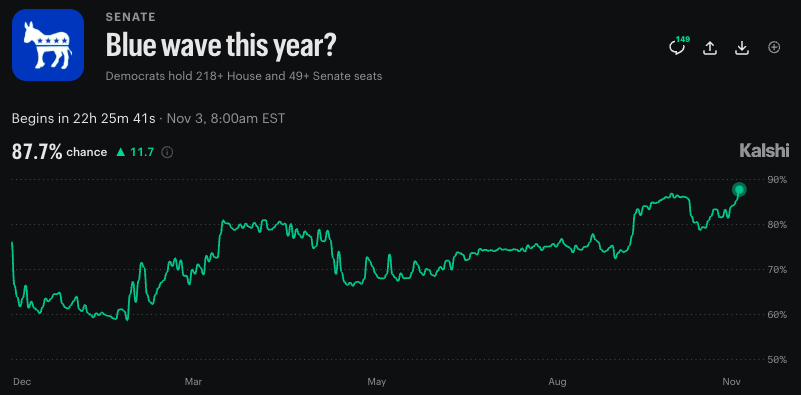
Midterm Blue Wave Odds: Will There Be a Blue Wave? Kalshi Prices It at 87.7%
- POLITICS OCT 29, 2026
Who Will Win the US Senate? 2026 Senate Control Vegas Odds & Predictions
- POLITICS NOV 3, 2026
Texas Senate Race Vegas Odds: Paxton vs. Talarico
- POLITICS NOV 3, 2026
Maine Senate Election Odds: Troy Jackson 69% Favorite on Polymarket and Kalshi
- POLITICS NOV 2, 2026
Ohio Senate Odds: Husted vs. Brown Odds on Polymarket and Kalshi
- POLITICS NOV 2, 2026
Michigan Senate Odds: Abdul El-Sayed vs. Mike Rogers Odds