

How to Use AI for Sports Betting

Sports betting and sportsbooks have always rewarded people who can price a game faster and cleaner than the market. That part hasn’t changed. What has changed is how much of the grunt work AI can handle for you, from sorting props to flagging numbers that deserve a second look.
AI isn’t a shortcut to winning, and it shouldn’t make the decision for you. What it can do is help you move through a crowded slate faster, compare your number to the market, and spend more time on the bets worth a closer look.
If you want a betting-specific option instead of building your own prompts or models, Playbook is one tool to check out. Here’s how AI tools like that fit into a betting routine.
TL;DR
- AI is most useful for pricing bets, sorting props, and narrowing a full board
- If your number is close to the sportsbook number, there may be nothing to bet
- Shop the line before you place anything
- Use AI to get to the short list faster, then check lineup and injury news yourself
- If a tool is pushing you toward more bets than usual, that’s a problem, not an edge
- As of March 2026, Playbook supports NFL, NBA, MLB, NHL, college football, and college basketball. It doesn’t currently support soccer, tennis, teasers, futures, cross-sport parlays, or player-combo markets.
BEYOND THE SPREADSHEET: WHAT AI DOES

At the simplest level, AI helps you do the same job bettors have always tried to do, just faster. Traditional handicapping means checking injuries, weather, usage, travel spots, market movement, matchup history, and a pile of other inputs, then trying to turn all of that into a fair number. AI can scan more of that at once and get you to a smaller list of bets worth your time faster.
That speed matters most on bigger boards. A bettor doing everything by hand might be able to go deep on a few games, but AI can help you screen an entire Saturday card, then decide which spots deserve the deeper work.
PREDICTIVE MODELING AND IDENTIFYING VALUE
A lot of AI betting strategies come down to one basic idea: build a baseline number, then compare it to the market. That’s what predictive modeling is really doing here.
Whether the output is a point spread, total, or prop projection, the point isn’t to guess the exact final score. The point is to ask whether the sportsbook’s number looks a little high, a little low, or basically right. If your projection lands close to the market, there may be no bet. If the gap looks meaningful, then you have something worth checking.
FINDING THE DISCREPANCY
Say a sportsbook hangs Chiefs -3. If your own AI-assisted process makes that game closer to Chiefs -4.5 or -5, now you at least have a reason to stop and look harder. Not to auto-bet it, just to look harder.
Then comes the part some people skip. Is the number still there across books? Did the market already move? Is there injury or lineup news explaining the difference? Was the edge big enough to matter once you account for juice? If the answer to those questions still points the same way, then you may have something.
SENTIMENT ANALYSIS: THE CONTRARIAN APPROACH
Sentiment analysis, in betting terms, just means tracking what the public is reacting to. That can include social posts, headlines, injury buzz, or the kind of hype cycle that shows up when one team suddenly becomes everybody’s favorite side. That can matter because markets don’t always move on pure matchup strength alone. They also move on attention, opinion, and where bettors are naturally piling in.
Used well, AI can help flag those moments faster. Maybe a team is getting a ton of noise online, but the number has barely moved. Maybe the coverage around a player is louder than the actual impact on the game. That doesn’t mean you blindly fade the public every time. It just gives you another piece of context before you decide whether the market is overreacting.
THE HYBRID HANDICAPPER: MAN VS. MACHINE
AI is useful for repetitive work. Running projections, sorting props, scanning slates, comparing numbers. The human side is still useful for everything that doesn’t fit neatly into a model, like role changes, coaching tendencies, late lineup tone, or whether a player technically being active tells the full story.
That’s why this doesn’t need to be framed as numbers versus feel: the better setup is using both. Let the AI narrow the board, and let your own judgment decide whether the bet still makes sense.
INTEGRATING AI INTO YOUR DAILY WORKFLOW
If you want to use AI for sports betting without turning it into a whole project, keep the process simple.
- Run the numbers: Start with one market you already know well, whether that’s NFL sides, NBA props, or MLB totals. Ask for a fair spread, total, or prop line. You’re looking for a baseline, not a lock.
- Spot the deltas: Compare that number to the sportsbook market. If your projection is basically in line with the board, move on. If there’s a gap, flag it.
- Layer context: Before you place anything, check the real-world stuff. Is the lineup confirmed? Has the line already moved? Is there weather, travel, or a workload concern the model may not be capturing well?
- Execute or pass: Sometimes the bet still makes sense, and sometimes it doesn’t. Passing is part of the process.
USING PLAYBOOK TO SIMPLIFY YOUR RESEARCH
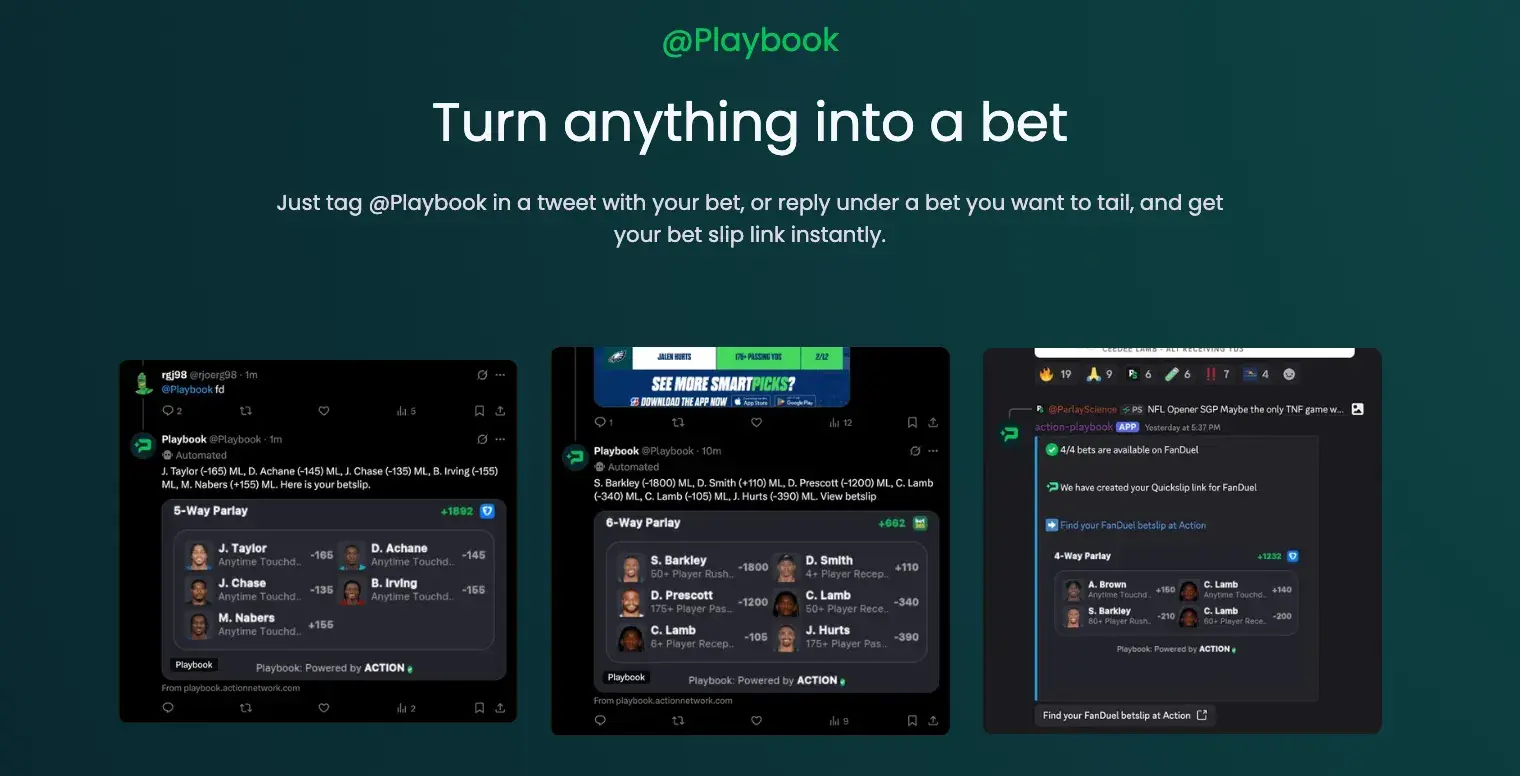
You don’t need to build your own model or be especially technical to use AI gambling tools, and that’s a big part of the appeal here. Consumer tools exist to help bridge the gap between raw betting data and an actual bet you can review. Playbook fits into that category.
Playbook Picks Hub sits inside the Action Network app’s Picks section and lets users filter betting opportunities by league and market. The platform’s bot works on X and Discord by returning a link that opens a supported sportsbook with the requested bet already loaded into the slip.
As of March 2026, Playbook supports NFL, NBA, MLB, NHL, college football, and college basketball. Its current support pages say soccer, tennis, teasers, futures, cross-sport parlays, and player-combo markets aren’t supported right now. Playbook compares odds across supported books and currently works with sportsbooks such as FanDuel, DraftKings, BetMGM, bet365, and Caesars, with more books coming.
That makes Playbook useful for a pretty specific part of the betting routine: getting from idea to reviewable betslip faster. You still have to decide whether the number is worth betting.
FAQS: USING AI IN YOUR BETTING STRATEGY
IS IT LEGAL TO USE AI FOR SPORTS BETTING?
Yes. Using AI to research a bet is no different from using stats, projections, or spreadsheets. The bet itself still has to be placed where sports betting is legal and where the sportsbook is licensed to operate. 21+ and present where applicable.
CAN PLAYBOOK HELP ME WITH PROPS AND PARLAYS?
With some of them, yes. Playbook supports certain leagues and markets, but not everything. As of March 2026, Action says teasers, futures, cross-sport parlays, and player-combo markets are not supported right now.
IS THERE A "CHATGPT" FOR SPORTS BETTING?
Kind of, but not exactly. A general AI tool can help with research, comparisons, and quick questions. A betting-specific tool like Playbook makes more sense if you want supported-market filters and sportsbook-linked betslips.
DO SHARPS USE AI?
A lot of serious bettors (sharps) use models, automation, or some version of AI in their process, as it helps them price games faster and compare numbers quicker.